


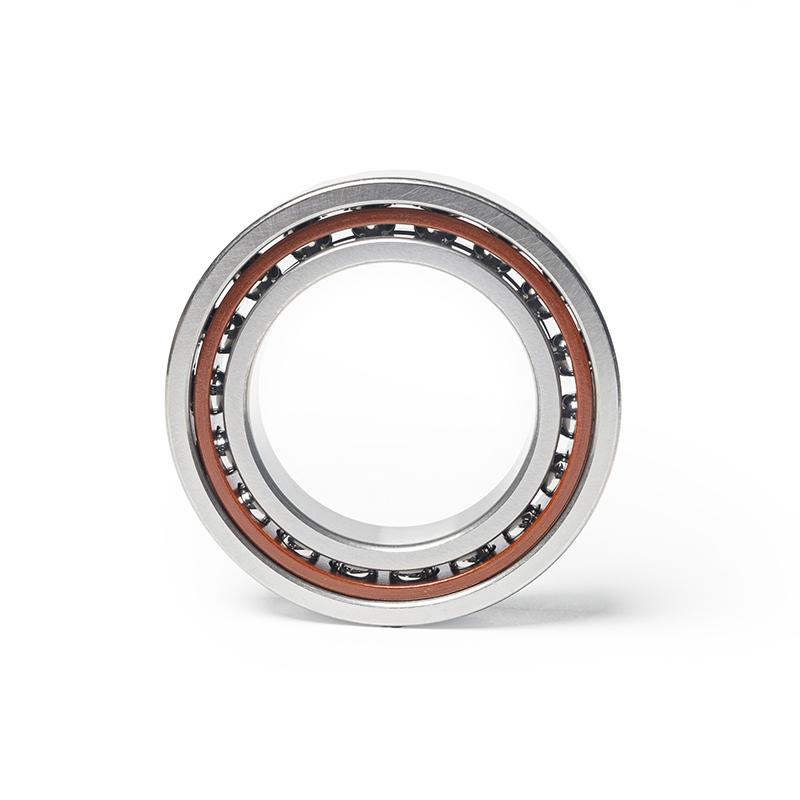
In the world of high-precision CNC machining and woodworking spindles, "Speed" is a double-edged sword. To achieve the perfect surface finish, you need high RPMs. However, as the speed increases, so does the internal friction. For many operators, this results in a "Spindle Burnout"—a catastrophic failure where the bearings seize due to heat, causing thousands of dollars in downtime.
The core problem isn't the machine's motor; it is the bearing's cross-section. When a bearing is too "heavy," it generates excessive centrifugal force. This is where the 70 angular contact ball bearing (part of the ISO 07 dimension series) acts as the specific mechanical solution.
1. Solving the "Centrifugal Force" Failure
In high-speed rotation, the balls inside a bearing are pushed outward by centrifugal force. In "heavy" series bearings (like the 72 or 73 series), the balls are larger and heavier. At 15,000+ RPM, these balls press so hard against the outer raceway that they create "skidding" and intense heat.
The 70 Series Solution: The 70 angular contact ball bearing is designed with a "light" cross-section.
-
The Fix: Smaller balls mean less mass. Less mass means significantly lower centrifugal force at high speeds.
-
The Result: By switching to a 70 series, you can run your spindle at higher RPMs with lower operating temperatures, effectively solving the problem of heat-induced seizure.
2. Eliminating "Spindle Grow" (Thermal Expansion)
A common headache for precision grinders is that the machine’s accuracy changes as it warms up. This "Thermal Drift" happens because the bearings get hot, the shaft expands, and the tool bit shifts by several microns.
How the 70 Series Fixes This:
Because the 70 angular contact ball bearing has a smaller surface area and optimized internal geometry, it dissipates heat faster than bulkier bearings.
-
Advanced Cages: Most 70 series bearings for high-speed use feature phenolic resin cages (textile-reinforced). These cages are lightweight and hold lubrication better, reducing the friction that causes thermal growth.
-
Precise Contact Angles: By selecting a 15° (C) or 25° (AC) contact angle, engineers can "tune" the bearing to handle the specific axial thrust of the machine without generating unnecessary heat.
3. Resolving Axial "Play" in Multi-Axis Milling
If your machine produces parts with "chatter" marks, your spindle lacks axial stiffness. Standard bearings allow the shaft to move back and forth slightly under pressure.
The Semantic Fix: 70 series bearings are almost always used in matched sets (Duplex or Triplex).
-
Back-to-Back (DB) Arrangement: This setup creates a wide "effective bearing spread." It locks the shaft in place, making it impossible for the spindle to tilt or shift.
-
Preload Calibration: These bearings are manufactured to P4 or P2 precision classes, allowing for "Light" or "Medium" preloads that remove all internal clearance. This solves the problem of vibration, resulting in a mirror-like surface finish on your workpieces.
Performance Troubleshooting: 70 Series Matrix
| Machine Problem | Root Cause | The 70 Series Solution |
| Sudden Spindle Seizure | Excessive ball mass/heat | Light-duty 70 series reduces centrifugal load |
| Wavy Finish (Chatter) | Insufficient axial rigidity | P4 matched sets with controlled preload |
| Accuracy Drift | Thermal expansion of races | High-speed phenolic cages and thin-section design |
| Short Bearing Life | Lubricant breakdown | Optimized internal volume for better grease flow |
Reducing the Total Cost of Ownership (TCO)
The "problem" many procurement departments face is looking at the initial cost of a precision bearing. Yes, a 70 angular contact ball bearing with a P4 precision rating costs more than a standard ball bearing. However, the "Real Cost" of using the wrong bearing includes:
-
Scrapped Parts: Due to vibration and inaccuracy.
-
Labor Costs: For frequent spindle rebuilds.
-
Electricity: Overheating bearings draw more power from the motor.
By solving the friction and rigidity problems at the source, the 70 series pays for itself within the first few months of high-speed operation. It is the professional's choice for turning a "troubled" spindle into a reliable production asset.
Conclusion: Engineering for Speed and Precision
If your high-speed equipment is failing to meet tolerances or running too hot, the solution isn't to slow down—it’s to upgrade the support. The 70 angular contact ball bearing provides the perfect balance of lightweight design and high-speed stability.
By addressing the fundamental mechanical issues of centrifugal force and thermal drift, you move from "reactive maintenance" to "precision performance." Stop fighting your spindle’s limitations and start optimizing with the 70 series.

 English
 Arabic
 French
 Spanish
 Portuguese
 Deutsch
 Turkish
 Dutch
Dutch
 Italiano
 Russian
 Romaian
 Portuguese (Brazil)