


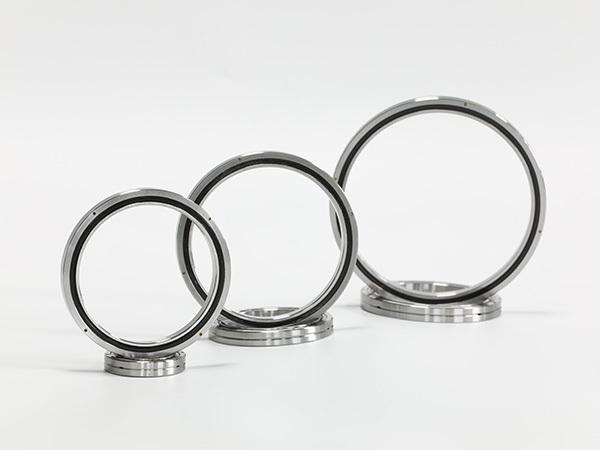
The RA cross roller bearing is a high-precision component where the rollers are oriented perpendicularly to each other. This allows a single-row bearing to carry radial, axial, and moment loads. While this is efficient, the rings of an RA series bearing are thin. This means the bearing lacks the structural mass to "self-correct" for imperfect housings.
If your rotational system feels "notchy" or loses its micron-level repeatability, the problem is likely at the interface between the bearing and your machinery.
1. The "Ovality" Problem: Housing and Shaft Tolerances
In standard bearings, the thick rings can often mask minor imperfections in the housing bore. With an RA cross roller bearing, the ring is so thin that it will conform to the shape of the housing.
-
The Problem: If your housing bore is even slightly out-of-round (ovality), the bearing ring becomes elliptical. This changes the internal clearance, causing the rollers to "pinch" at the narrow axis of the ellipse.
-
The Symptom: Two distinct "high-torque" spots per 360-degree rotation.
-
The Solution: You must verify your housing and shaft tolerances using a bore gauge. For RA series bearings, we recommend a "Transition Fit" or a very light "Interference Fit." If the fit is too tight, you will eliminate the internal preload margin and cause the bearing to seize as it reaches operating temperature.
2. Solving "Stick-Slip" and Torque Fluctuations
Precision robotics require smooth, low-torque motion. When an RA bearing exhibits "stick-slip" (a jerky, non-linear motion), it is often a result of spacer pinching.
Inside the RA series, spacers or "separators" keep the rollers from rubbing against each other. In thin-section bearings, if the mounting surface isn't perfectly flat, the raceway can distort vertically.
-
The Cause: Uneven mounting pressure causes the spacers to tilt. This increases the "running torque" and can cause the motor to hunt for its position, leading to vibration.
-
The Expert Fix: Ensure the mounting flanges have a flatness tolerance that matches the bearing’s precision grade (typically within 2-5 microns for P5/P4 grades). Use a "Star Tightening" sequence on your mounting bolts to distribute pressure evenly.
3. Thermal Runaway in High-Duty Cycles
Because the RA cross roller bearing has a very small mass, it has a low "thermal inertia." It heats up quickly and cannot dissipate that heat as effectively as a larger bearing.
As the rollers expand, the internal preload ($P$) increases. This creates more friction, which creates more heat—a cycle known as thermal runaway.
Where $Q$ is the heat generated and $\Delta T$ is the temperature difference between the inner and outer ring. If the inner ring (on the shaft) gets hotter than the outer ring (in the housing), the internal clearance disappears.
-
Maintenance Tip: For high-duty applications, use a synthetic lubricant with a high Viscosity Index (VI). This ensures the oil film remains stable even as the thin-section rings heat up.
4. Semantic Nuance: Moment Stiffness and Tilting
The RA series is designed to handle overturning moments. However, because the rings are thin, the "stiffness" of the joint is heavily dependent on the support from the housing.
If your robotic arm "droops" when fully extended, the bearing might be undersized for the Moment Load ($M$).
-
Calculation Check: Always ensure your static safety factor ($f_s$) is above 2.0 for applications with high shock or vibration. If you are hitting the limit of the RA series, you may need to move to a specialized RU series (integrated holes) or increase the diameter of the RA bearing to gain a larger moment-arm base.
Technical Comparison: RA Series vs. RB Series
| Feature | RB Series (Standard) | RA Series (Slim-Type) |
| Ring Thickness | Standard | Ultra-Thin |
| Weight | Higher | 25-40% Lighter |
| Space Saving | Good | Excellent |
| Mounting Sensitivity | Moderate | Very High |
| Typical Precision | P5, P4, P2 | P5, P4, P2 |
5. Lubrication Strategy for Minimal Torque
In many RA applications, such as optical sensors or medical imaging, "low startup torque" is critical.
-
Avoid Over-Greasing: Overfilling an RA bearing causes "churning," which spikes the torque. Aim for a 15% to 25% grease fill for low-torque precision.
-
Contamination Control: Because the clearance is so small, even a 2-micron particle can cause a catastrophic "score" on the V-groove. Always use integrated seals (UU suffix) if the environment isn't a cleanroom.
Conclusion
Success with an RA cross roller bearing is found in the preparation of its environment. By solving for housing ovality, ensuring absolute mounting flatness, and managing the thermal profile of your slim-section joints, you can achieve the high-rigidity performance this bearing was designed for. In the world of precision motion, the bearing is only as good as the surface it rests upon.

 English
 Arabic
 French
 Spanish
 Portuguese
 Deutsch
 Turkish
 Dutch
Dutch
 Italiano
 Russian
 Romaian
 Portuguese (Brazil)