


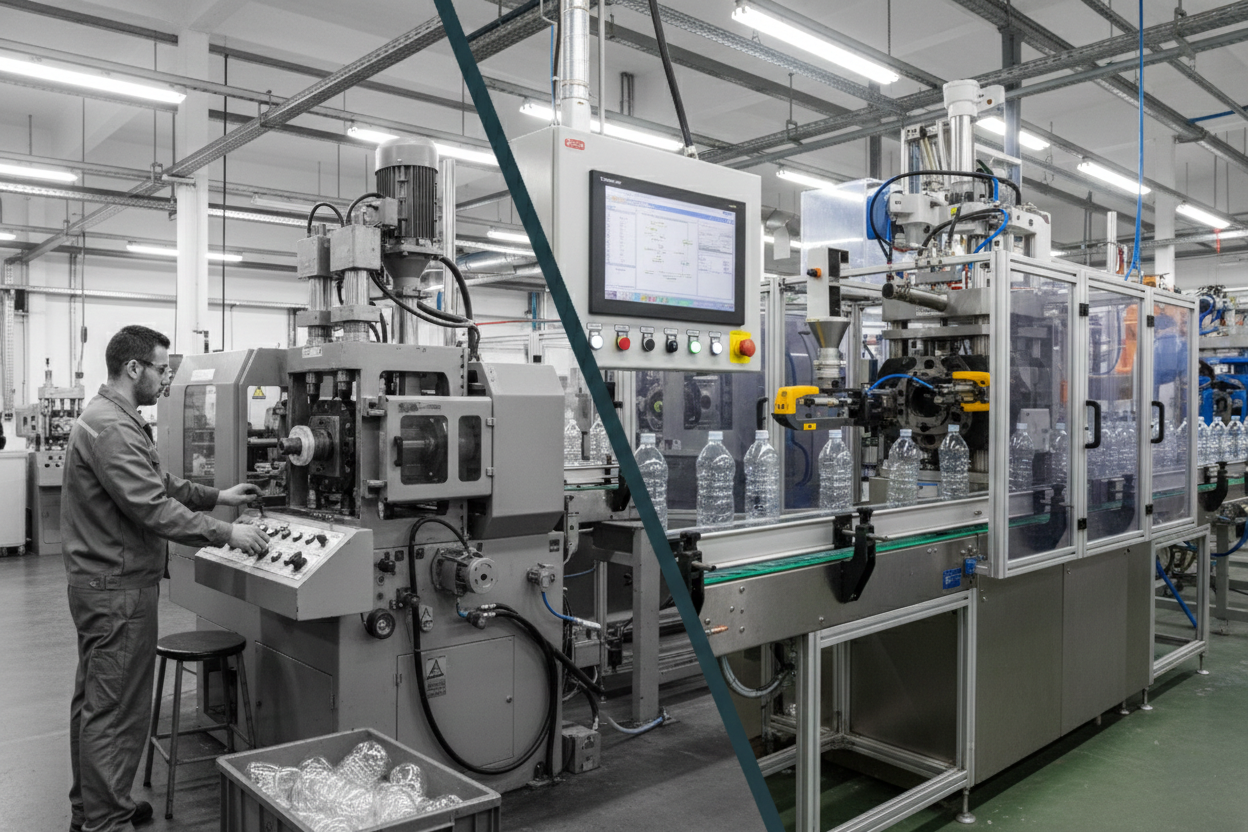
Blow molding machines are central to modern plastic manufacturing, producing everything from everyday beverage bottles to industrial containers. As manufacturing needs to grow, factories face a critical decision: whether to rely on manual blow molding machines or invest in automated systems. Both have advantages, but automated blow molding machines often demonstrate clear cost-effectiveness, especially in large-scale production environments.
Understanding the differences between automated and manual machines, the financial implications, operational efficiency, and material handling capabilities is essential for manufacturers seeking to optimize production. This article explores the benefits, challenges, and cost considerations of automated blow molding machine versus manual setups.
Understanding Manual and Automated Blow Molding Machines
Manual blow molding machines are typically operated with direct human intervention. Operators feed plastic material, control air pressure, monitor cooling, and adjust parison thickness based on experience. While manual machines can produce high-quality products, they require significant labor and constant supervision.
Automated blow molding machines, in contrast, integrate computer operating systems that control heating zones, screw speed, air pressure, parison thickness, and cooling cycles. These systems allow consistent product quality, reduce labor dependency, and optimize production flow over long shifts.
Key Differences Between Manual and Automated Systems
Labor Requirements
Manual machines demand continuous operator presence. Each batch requires monitoring to prevent defects, adjust temperatures, or handle inconsistent material flow. Labor costs, therefore, become a significant factor in overall production expense.
Automated blow molding machines reduce dependency on skilled labor. Operators still monitor the system, but most adjustments are handled automatically, reducing human error and enabling fewer personnel to manage larger production volumes.
Production Consistency
Manual systems rely heavily on operator skill. Even minor inconsistencies in timing or temperature can lead to variations in wall thickness or product shape.
Automated systems deliver consistent parison thickness, accurate mold inflation, and precise cooling, which ensures uniform quality across batches. This consistency lowers waste and improves predictability for high-volume orders.
Material Efficiency
Material loss occurs more frequently in manual setups due to uneven parison formation or air pressure mistakes. Each defective product represents wasted raw material and energy.
Automated extrusion blow molding machines continuously monitor flow and pressure. They can adjust in real time to maintain uniform walls and minimal scrap, making them far more material-efficient in long-term production.
Financial Implications
Initial Investment
Automated blow molding machines generally have a higher upfront cost compared to manual machines. Factories need to account for machinery price, software integration, and installation.
Manual machines are more affordable initially but require higher ongoing labor and maintenance costs to maintain quality and production rates.
Operational Costs
Automated systems reduce labor expenses and energy consumption through optimized cycles. Less downtime and lower scrap rates further decrease operational costs.
Manual systems, while cheaper to acquire, often consume more energy per product due to inconsistent processing and produce more defective units that increase material cost.
Return on Investment (ROI)
Though the initial investment in automation is higher, the long-term savings on labor, materials, and energy make automated blow molding machines more cost-effective over time. Factories producing high volumes benefit most, as efficiency gains compound over large-scale operations.
Production Efficiency Comparison
Cycle Times
Automated machines maintain continuous cycles without the delays associated with manual adjustments. High-speed extrusion blow molding machines can run multi-shift schedules with minimal supervision, drastically increasing throughput.
Manual machines are slower because each batch often requires monitoring, adjustments, and occasional trial-and-error to achieve the desired quality.
Product Quality
In manual machines, slight human errors can result in variable wall thickness, inconsistent weight, or minor defects. Automated systems minimize these errors through digital controls and real-time monitoring. This produces higher-quality products with fewer rejects.
Downtime
Downtime in manual systems is often linked to operator intervention or correction of mistakes. Automated blow molding machines incorporate predictive maintenance systems, alerting operators before potential failures, which reduces unplanned stoppages.
Comparison Table: Manual vs Automated Blow Molding Machines
| Feature | Manual Blow Molding Machine | Automated Blow Molding Machine |
|---|---|---|
| Labor Requirement | High, skilled operators needed | Low, operators supervise rather than adjust constantly |
| Production Speed | Slower, batch-based | Fast, continuous operation |
| Material Waste | Higher due to human errors | Low, controlled through real-time monitoring |
| Consistency | Moderate, dependent on operator skill | High, automated thickness and cooling control |
| Maintenance | Reactive, operator-dependent | Predictive, software-assisted monitoring |
| Energy Efficiency | Moderate, uneven cycles | High, optimized heating and cycle times |
| Initial Investment | Low | High |
| Long-Term Cost | Higher due to labor and waste | Lower due to efficiency gains |
| Product Quality | Variable | Consistent, fewer defects |
| ROI Timeline | Longer | Shorter for high-volume production |
Real-World Applications
Beverage Industry
Automated extrusion blow molding machines are widely used to produce PET and HDPE beverage bottles. Consistency is critical for bottling plants running 24/7, and automated systems ensure that bottle weight, wall thickness, and clarity remain uniform across thousands of units.
Chemical Packaging
In chemical packaging, precise wall thickness and material distribution are crucial for safety and durability. Automated machines allow manufacturers to produce large drums and containers with minimal material waste and predictable strength properties.
Personal Care Products
Squeeze bottles, cosmetic containers, and flexible packaging benefit from the precise control automated blow molding machine provide. The combination of computer-controlled temperature zones and real-time pressure adjustments allows manufacturers to achieve aesthetically perfect and functional products.
How Automation Reduces Waste and Enhances Efficiency
Automation optimizes material use by controlling parison formation and air pressure precisely. Real-time sensors detect any deviations, adjusting screw speed or air flow to maintain uniform wall thickness. Excess material is minimized, and trimmed scrap can often be recycled directly into production.
Energy efficiency is improved because heating zones maintain stable temperatures, avoiding frequent cycling. Fewer defects also reduce energy spent on reprocessing rejected items.
Integration With Computer Operating Systems
Modern blow molding machines integrate advanced computer operating systems to monitor and control every step of production. These systems allow factories to:
-
Store material profiles for different plastics
-
Adjust cycle times for different product sizes
-
Monitor machine health and predict maintenance needs
-
Maintain consistent wall thickness and product weight
-
Reduce operator intervention while increasing throughput
This integration is one of the main reasons automated blow molding machines deliver higher efficiency and cost-effectiveness.
Challenges of Automated Systems
While automation offers many advantages, it comes with challenges. High initial investment, software training requirements, and occasional technical troubleshooting can be barriers for small manufacturers. However, for high-volume or multi-shift production, these challenges are outweighed by long-term savings.
Choosing the Right System
Factories need to assess their production volume, product types, labor costs, and quality requirements before choosing between manual and automated blow molding machines. For companies producing thousands of units daily or multiple product lines, automation almost always proves more cost-effective. Manual systems may still be suitable for low-volume or specialized production runs.
Surgery
Automated blow molding machines clearly provide a more cost-effective solution for large-scale plastic manufacturing compared to manual machines. They reduce labor requirements, improve material efficiency, maintain consistent product quality, and optimize production cycles.
Investing in automated extrusion blow molding machines allows manufacturers to handle high-volume production, minimize waste, and meet modern industrial demands efficiently. While manual sewing machines for small-scale or occasional production, automation ensures that factories remain competitive, energy-efficient, and profitable in today's fast-paced plastic manufacturing environment.
For manufacturers in the region, considering Blow Molding Machines in UAE with automation and computer operating systems can provide a reliable long-term solution for stable and efficient plastic production.
Visit for news and updates at newenglandbiodiesel.net

 English
 Arabic
 French
 Portuguese
 Deutsch
 Turkish
 Dutch
Dutch
 Italiano
 Russian
 Romaian
 Portuguese (Brazil)
 Tiếng Việt