


In today’s fast-expanding power networks, selecting the right overhead line material is critical for system reliability, safety, and long-term cost control. Among all bare overhead conductor types, the ACSR conductor remains one of the most widely used solutions for medium- and high-voltage transmission and distribution projects worldwide.
This technical guide explains what an ACSR conductor is, how it is manufactured, where it performs best, and why utilities and EPC contractors continue to specify it for demanding grid applications. The information is written for engineers, project managers, and procurement professionals seeking dependable, standards-compliant transmission products.
What Is an ACSR Conductor?
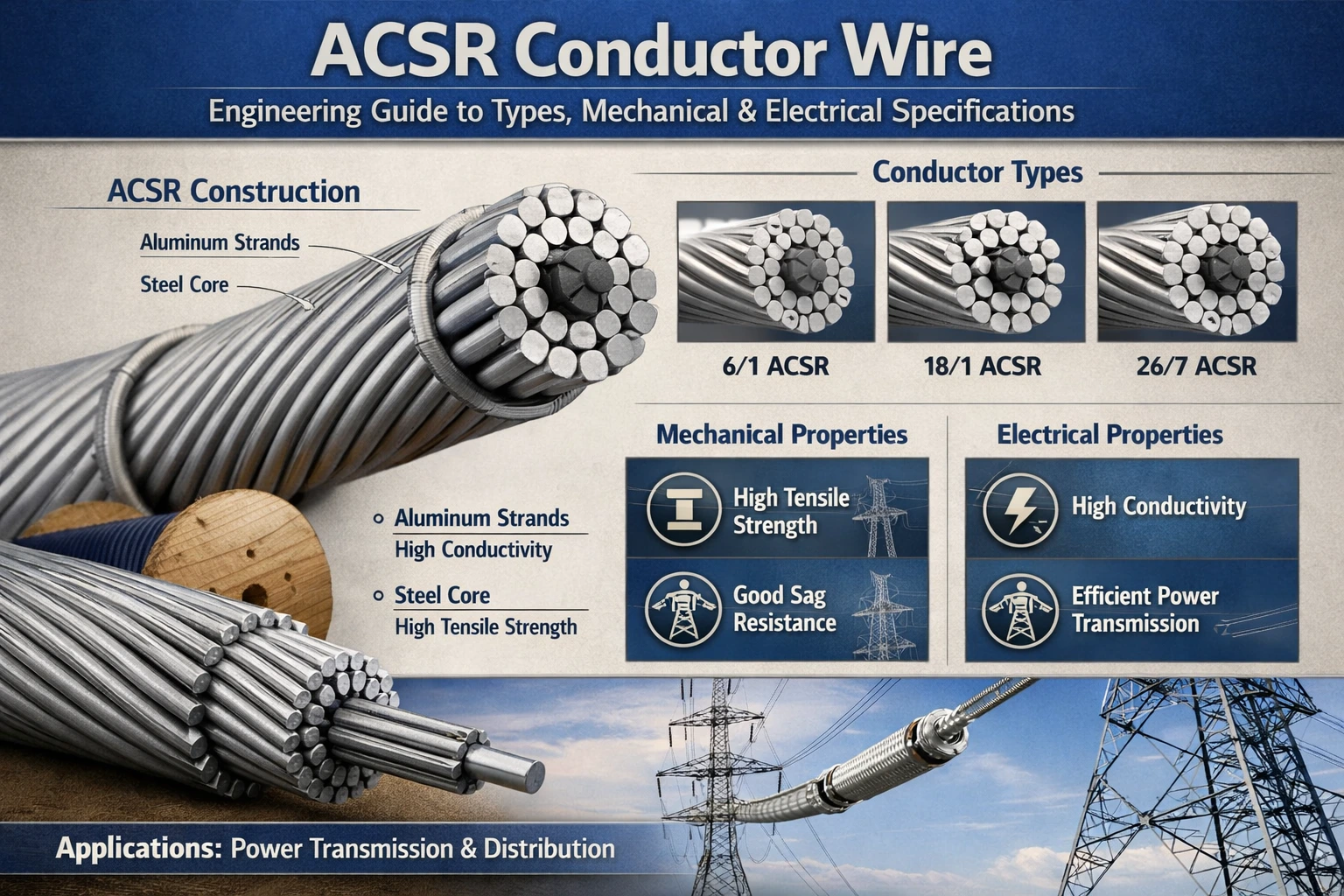
ACSR conductor stands for Aluminum Conductor Steel Reinforced. It is a composite overhead conductor made of:
-
An outer layer of high-purity aluminum strands
-
A central core of galvanized steel wires
The aluminum strands provide excellent electrical conductivity and corrosion resistance, while the steel core delivers high tensile strength. This combined structure allows ACSR conductors to span longer distances with reduced sag, even under heavy mechanical and climatic loads.
Because of this balance between electrical performance and mechanical strength, ACSR conductors are widely adopted in transmission lines, sub-transmission corridors, and large distribution feeders.
Typical Structure and Design of ACSR Conductor
Aluminum Outer Layers
The outer aluminum strands carry almost all the current. They are designed for:
-
Low electrical resistance
-
High flexibility for installation
-
Strong resistance to environmental degradation
Steel Reinforced Core
The steel core acts as the mechanical backbone of the conductor and is responsible for:
-
High breaking load
-
Improved resistance to wind and ice loading
-
Long-span capability across rivers, highways, and valleys
The strand configuration can be customized according to project requirements such as sag limits, span length, and tower geometry.
ACSR Conductor Manufacturing Process Overview
The ACSR conductor manufacturing process involves precision control at every stage:
-
Aluminum wire drawing – Electrical-grade aluminum rods are drawn into uniform strands.
-
Steel wire preparation – High-strength steel wires are galvanized for corrosion protection.
-
Core stranding – The steel wires are stranded to form the reinforced core.
-
Aluminum stranding – Aluminum layers are stranded concentrically over the steel core.
-
Final inspection and testing – Electrical resistance, tensile strength, dimensional tolerance, and surface quality are verified.
This controlled process ensures consistent performance across long transmission routes and high-duty operating environments.
Key Performance Advantages of ACSR Conductor
High Mechanical Strength
Compared with standard AAC conductors, ACSR conductors offer significantly higher tensile strength, making them suitable for:
-
Long spans
-
Mountainous and coastal regions
-
Areas exposed to strong wind or ice loading
Optimized Electrical Efficiency
The aluminum layers provide excellent conductivity while keeping conductor weight manageable. This helps utilities achieve:
-
Lower line losses
-
Stable current-carrying performance
-
Improved overall transmission efficiency
Cost-Effective Grid Expansion
For many grid projects, ACSR remains a cost-effective solution compared with advanced composite or special alloy conductors, especially where mechanical strength is the primary design driver.
Where ACSR Conductor Is Commonly Used
ACSR conductor is widely applied in:
-
High-voltage transmission lines
-
Sub-transmission corridors
-
Long-span crossings
-
Rural and semi-urban distribution networks
-
Grid reinforcement and reconductoring projects
Its proven reliability makes it a preferred choice for both new network construction and capacity upgrades.
Compliance With International Standards
To ensure long-term safety and interchangeability, ACSR conductors are typically produced in compliance with recognized international standards such as:
-
International Electrotechnical Commission (IEC)
-
ASTM International
-
Institute of Electrical and Electronics Engineers
These standards define requirements for conductor dimensions, mechanical strength, electrical resistance, and quality assurance procedures.
Why Engineers and Utilities Still Choose ACSR Conductor
From an engineering and procurement perspective, ACSR conductor delivers a strong combination of:
-
Proven field performance
-
Simple handling and installation
-
Broad availability of fittings and accessories
-
Compatibility with existing tower and hardware designs
For EPC contractors and utilities managing tight construction schedules, this practical reliability reduces project risk and simplifies supply planning.
ACSR Conductor Solutions from HNBF Power
HNBF Power is a global manufacturer of overhead conductors and power cables, supplying ACSR, AAC, AAAC, ABC cable, LV power cable, and concentric cable solutions for utility-scale transmission and distribution networks.
As an experienced bare conductor supplier serving international grid projects, HNBF Power provides:
-
Custom strand constructions for specific span and loading conditions
-
Utility-approved materials and quality control systems
-
Full inspection documentation for transmission and distribution projects
-
Engineering support for conductor selection and line design compatibility
Whether the project involves long-span crossings, regional grid reinforcement, or new distribution corridors, HNBF Power supports utilities and EPC contractors with stable production capacity and technical consistency.
Selecting the Right ACSR Conductor for Your Project
When specifying an ACSR conductor, engineers and buyers should carefully evaluate:
Mechanical Requirements
-
Maximum span length
-
Wind and ice loading conditions
-
Required safety factor
Electrical Requirements
-
Continuous and emergency current ratings
-
Line losses and voltage drop targets
-
Network expansion planning
Installation and Logistics
-
Drum sizes and transport limitations
-
Stringing tension constraints
-
Compatibility with existing fittings
A properly selected ACSR conductor directly improves system reliability and long-term maintenance performance.
Frequently Asked Questions (FAQs)
1. What is the main advantage of ACSR conductor over AAC?
The main advantage is significantly higher mechanical strength due to the steel core, making ACSR conductor more suitable for long spans and harsh environmental conditions.
2. Is ACSR conductor suitable for coastal or high-humidity regions?
Yes. With properly galvanized steel core and high-quality aluminum strands, ACSR conductors perform reliably in coastal and humid environments.
3. Can ACSR conductor be used for reconductoring projects?
Absolutely. ACSR conductor is commonly used in reconductoring because it offers higher strength while remaining compatible with many existing tower and hardware designs.
4. How long is the typical service life of an ACSR conductor?
When manufactured to international standards and installed correctly, ACSR conductors typically deliver decades of reliable service in transmission and distribution networks.
5. Can ACSR conductor be customized for special spans?
Yes. Strand configuration, steel core size, and aluminum layers can be customized to match project-specific mechanical and electrical requirements.
Power Your Grid Projects with HNBF Power
If you are planning a new transmission line, upgrading an existing corridor, or sourcing a reliable ACSR conductor supplier for utility or EPC projects, HNBF Power is ready to support your requirements.
Contact HNBF Power today to discuss customized ACSR conductor solutions designed for your grid, your standards, and your long-term performance goals.

 English
 Arabic
 French
 Spanish
 Portuguese
 Deutsch
 Turkish
 Dutch
Dutch
 Russian
 Romaian
 Portuguese (Brazil)
 Tiếng Việt