


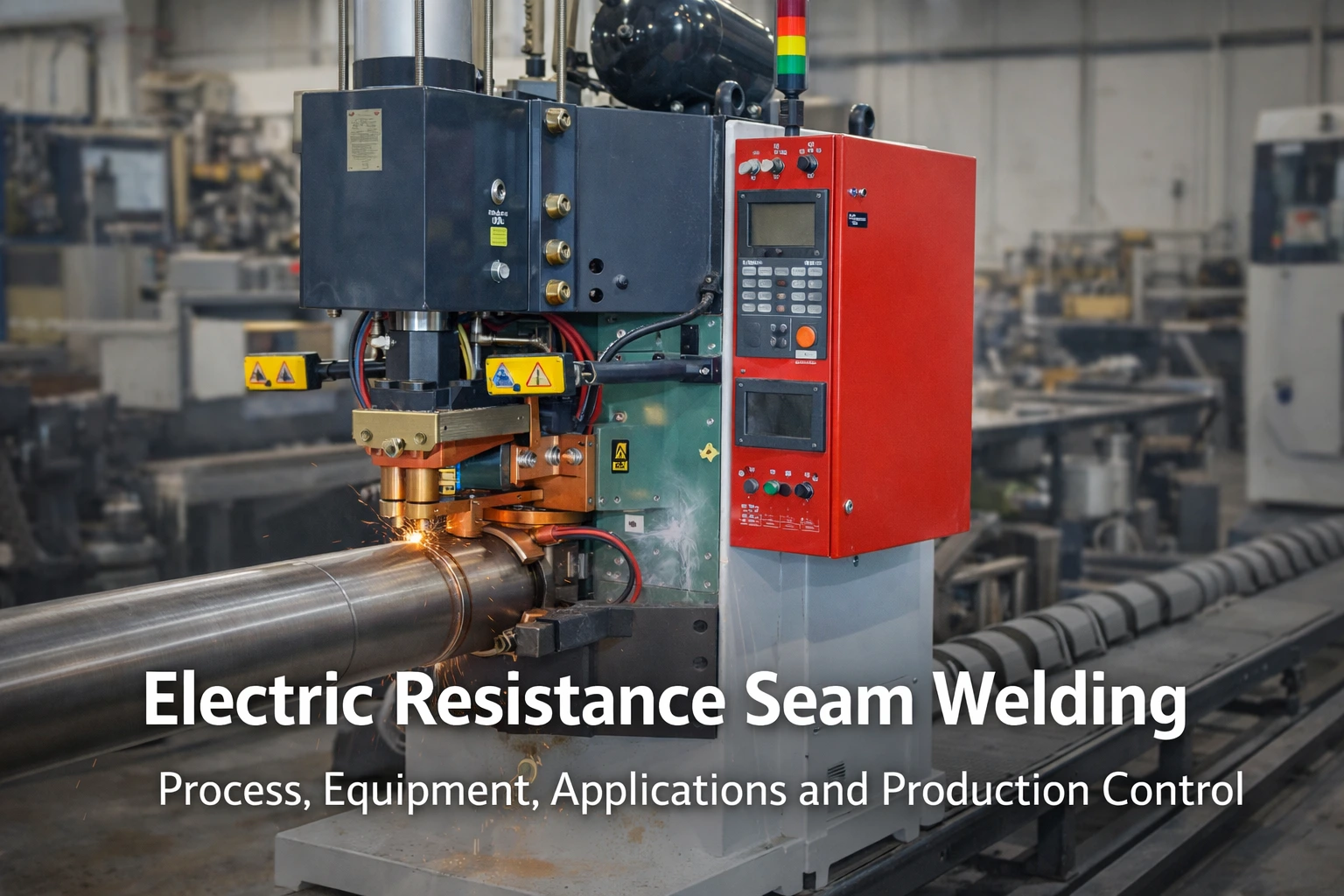
In modern manufacturing, precision, speed, and reliability in joining metal components are crucial for productivity and product quality. Electric resistance welding (ERW) has emerged as a cornerstone technology in industrial fabrication, offering a cost-effective, high-speed, and automated solution for assembling metal parts. Heron Welder, a global leader in industrial welding and metal-joining equipment, provides a comprehensive range of ERW machines, including spot, projection, seam, MFDC, and capacitor discharge systems designed for diverse industrial applications.
In this guide, we will explore the fundamentals of electric resistance welding, its applications, advantages, best practices, and how Heron Welder supports manufacturing engineers and OEMs with cutting-edge solutions.
What is Electric Resistance Welding?
Electric resistance welding is a process in which heat generated by electrical resistance is used to join metal surfaces. Unlike traditional welding, which relies on external heat sources like torches or lasers, ERW converts electrical energy directly into heat at the contact point between metals.
Key Principles of ERW
-
Electrical Resistance Heating:
When an electric current passes through the metals to be joined, the resistance at the interface generates localized heat. -
Pressure Application:
Mechanical pressure is applied to the heated metal surfaces, forcing them together to form a strong metallurgical bond. -
Cooling and Solidification:
The joint is allowed to cool under pressure, solidifying the weld without the need for filler materials.
This combination of electrical current and pressure allows ERW to produce high-quality, repeatable welds, making it ideal for mass production environments.
Types of Electric Resistance Welding
Heron Welder offers a diverse range of ERW solutions, each tailored to specific industrial requirements:
1. Spot Welding
Spot welding is one of the most common forms of ERW. It joins overlapping sheets at discrete points, often used in automotive body assembly, appliance manufacturing, and sheet metal fabrication.
Advantages:
-
High-speed joining
-
Minimal distortion
-
Suitable for thin metal sheets
2. Seam Welding
Seam welding creates a continuous weld along overlapping metal edges. It is commonly used in manufacturing fuel tanks, pipes, and metal drums.
Advantages:
-
Continuous, leak-proof joints
-
Ideal for cylindrical or flat sheet applications
-
Can be fully automated for high-volume production
3. Projection Welding
Projection welding uses embossed or raised areas on metal surfaces to concentrate current and heat at specific points. It is widely used in automotive components, electrical parts, and fastener assemblies.
Advantages:
-
Precise weld location
-
Reduces electrode wear
-
Supports thicker and irregular metal shapes
4. MFDC and Capacitor Discharge Welding
Medium Frequency Direct Current (MFDC) and capacitor discharge welding are specialized ERW techniques for high-speed precision welding, particularly for thin or heat-sensitive metals.
Advantages:
-
Fast welding cycles
-
Excellent for delicate or high-strength alloys
-
Minimal heat-affected zones
Applications of Electric Resistance Welding
ERW is highly versatile and used across numerous industries:
-
Automotive: Body panels, battery tabs, chassis components
-
Appliances: Refrigerators, washing machines, and HVAC units
-
Electrical and Electronics: Switchgear, transformers, connectors
-
Aerospace and Defense: Lightweight sheet assemblies and structural components
-
Industrial Manufacturing: Pipes, drums, tanks, and structural frames
Heron Welder provides customized ERW solutions for each of these industries, ensuring maximum efficiency, precision, and automation integration.
Advantages of Electric Resistance Welding
Manufacturers and factory managers increasingly adopt ERW due to its distinct benefits:
-
High Productivity: ERW machines can achieve thousands of welds per hour.
-
Automation-Friendly: Easily integrated into automated production lines.
-
Energy Efficiency: Uses electrical energy directly, reducing heat loss.
-
Minimal Consumables: No filler metal required for most ERW types.
-
Consistent Quality: Repeatable welds with minimal operator dependency.
Best Practices for Successful ERW
To maximize weld quality and process efficiency:
-
Surface Preparation: Ensure clean, oxide-free metal surfaces.
-
Optimal Current and Pressure Settings: Use precise electrical parameters based on metal thickness and type.
-
Electrode Maintenance: Regularly inspect and replace electrodes to maintain weld consistency.
-
Proper Cooling: Adequate cooling prevents overheating and ensures metallurgical integrity.
-
Automation Integration: Implement sensors and controllers to monitor weld quality in real-time.
Heron Welder machines are equipped with advanced control systems that simplify these best practices, making them suitable for both small-scale workshops and fully automated industrial lines.
Heron Welder: Your ERW Solution Partner
Heron Welder has established itself as a trusted global provider of electric resistance welding equipment and automated metal-joining solutions. From spot and seam welders to high-speed MFDC and capacitor discharge machines, Heron combines robust engineering, precision controls, and tailored automation to help manufacturers achieve productivity, quality, and cost-efficiency.
Whether you are an OEM, factory engineer, or system integrator, Heron provides:
-
Customized ERW machine design and automation integration
-
Expert technical support and training
-
Full-service installation, commissioning, and maintenance
FAQs About Electric Resistance Welding
Q1: What metals can be welded with ERW?
A1: ERW is suitable for a wide range of metals, including steel, stainless steel, aluminum, and copper alloys.
Q2: How does ERW compare to traditional arc welding?
A2: ERW is faster, highly automated, and produces minimal distortion, making it ideal for sheet metals and repetitive production, whereas arc welding offers more flexibility for complex geometries.
Q3: Can ERW be automated?
A3: Yes. ERW machines are fully compatible with robotic arms, conveyors, and PLC systems for high-volume industrial automation.
Q4: What industries benefit most from ERW?
A4: Automotive, appliance, electrical, aerospace, and industrial manufacturing benefit most due to ERW’s speed, precision, and scalability.
Q5: How do I choose the right ERW machine?
A5: Selection depends on material type, thickness, weld type, production volume, and automation needs. Heron offers expert consultation to match machines with production requirements.
Conclusion
Electric resistance welding is a critical technology for modern manufacturing, offering speed, precision, and energy efficiency across multiple industries. By implementing ERW, manufacturers can achieve superior quality, repeatability, and scalability in metal-joining operations.
Heron Welder stands ready to deliver advanced ERW solutions tailored to your production needs. From consulting and custom machine design to full automation integration, Heron provides everything manufacturers require to optimize welding performance.
Contact Heron today to request a quote or discuss a customized electric resistance welding solution for your factory.

 English
 Arabic
 French
 Spanish
 Portuguese
 Deutsch
 Turkish
 Dutch
Dutch
 Italiano
 Russian
 Romaian
 Portuguese (Brazil)