


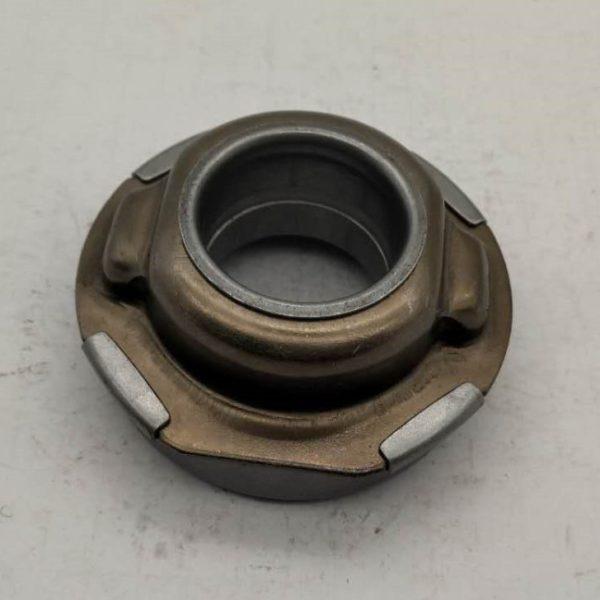
In the intricate world of manual transmissions, the clutch release bearing—often referred to as the "throw-out bearing"—is the critical bridge between the driver’s left foot and the engine’s power. As experts in the bearing and automotive friction industry, we have seen that while this component is small, its failure is almost always catastrophic for vehicle drivability.
If you have ever felt a strange pulsation through your clutch pedal or heard a high-pitched "chirp" that disappears the moment you press the pedal, you are witnessing the early stages of a bearing failure. In this guide, we will analyze the technical root causes of these issues and provide the problem-solving steps required to restore smooth gear transitions.
The Mechanical Pulse: How the Release Bearing Functions
The primary role of the clutch release bearing is to reduce friction between the stationary clutch fork and the rotating pressure plate diaphragm spring. When you depress the clutch pedal, the bearing slides along the transmission input shaft, pushing against the diaphragm spring to "disengage" the clutch disc from the flywheel.
The Problem: Because the bearing only spins when the clutch is depressed, it is subjected to sudden, high-speed rotational bursts and extreme axial loads. If the bearing’s internal lubrication is compromised or if the input shaft quill (the sleeve it slides on) is worn, the bearing will bind, overheat, and eventually seize.
Diagnosing the Failure: Identifying the "Chirp" and "Grind"
A failing clutch release bearing provides very specific auditory and tactile feedback. To solve the problem, you must distinguish it from other drivetrain issues like a bad pilot bearing or a worn synchro.
1. The Auditory "Reverse" Symptom
The most classic sign of a failing release bearing is a noise that starts when you press the pedal and stops when you release it. This is the opposite of a transmission input shaft bearing failure. The noise—often described as a whirring, grinding, or chirping—indicates that the internal ball bearings are no longer rolling smoothly within the race due to grease washout or surface pitting.
2. Pedal Pulsation and Vibration
If the bearing face (the part that contacts the pressure plate) becomes unevenly worn, it will not apply uniform pressure to the diaphragm spring fingers. This creates a rhythmic vibration or "shudder" felt through the driver's foot. Over time, this oscillation can cause the spring fingers to snap, requiring a full clutch kit replacement.
3. Difficult Gear Engagement
When a release bearing begins to seize, it may not travel fully along the guide sleeve. This results in an "incomplete release," where the clutch disc remains slightly in contact with the flywheel. This makes it difficult to shift into first gear or reverse from a standstill, often accompanied by a "crunching" sound from the gearbox.
Technical Solutions: Restoring Drivetrain Harmony
Solving a release bearing issue requires more than just a part swap; it requires a systemic approach to the clutch housing environment.
Precision Lubrication of the Guide Sleeve
One of the leading causes of premature failure is a "dry" guide sleeve. During installation, a specialized high-temperature, high-pressure grease (often molybdenum-based) must be applied to the slide surface. However, use caution: over-lubrication is just as dangerous. Excess grease can be flung onto the clutch friction material, causing the clutch to slip under load.
Inspecting the Clutch Fork and Pivot Ball
A release bearing is only as good as the hardware that pushes it. If the clutch fork is bent or the pivot ball is worn flat, the bearing will hit the pressure plate at an angle. This "off-center" loading is a primary cause of rapid bearing wear. Always inspect these "hidden" components for signs of metal fatigue or heat spotting.
The "Riding the Clutch" Warning
From a behavioral standpoint, the fastest way to destroy a high-quality release bearing is "riding the clutch." Keeping your foot lightly on the pedal keeps the bearing in constant contact with the spinning pressure plate. This leads to centrifugal force-induced heat, which thins the internal grease and leads to a "dry" bearing failure within months rather than years.
Selecting the Right Hardware
When choosing a replacement, ensure the bearing utilizes a self-aligning design. Modern high-performance clutch release bearings are engineered to compensate for minor misalignments between the engine and transmission, significantly reducing the lateral stress on the internal races.
Expert Maintenance Checklist:
-
Check the Hydraulics: Ensure the clutch slave cylinder is fully retracting. If the cylinder sticks, the bearing will stay in contact with the pressure plate, leading to overheating.
-
Surface Inspection: Check the diaphragm spring fingers for wear. If the fingers are "grooved," the old bearing was likely seized and dragging against them.
-
Total Kit Replacement: Because the labor to reach the bearing involves removing the transmission, we always recommend replacing the pressure plate, clutch disc, and pilot bearing simultaneously to reset the system's service life.
By identifying the symptoms of a failing clutch release bearing early, you can avoid being stranded with a pedal that won't return and a transmission that won't engage.

 English
 Arabic
 French
 Spanish
 Portuguese
 Deutsch
 Turkish
 Dutch
Dutch
 Italiano
 Russian
 Romaian
 Portuguese (Brazil)