


The Conversation That Happens Before You Buy Furniture
Most businesses approach office furniture procurement backwards. They start with product — browsing catalogues, visiting showrooms, comparing prices — and then try to fit what they found into the space and needs they have.
The businesses that end up with offices that genuinely work start with a different conversation entirely. They start with the question of what the space needs to do — for the people who work in it, for the clients who visit it, for the brand it needs to represent — and then figure out what furniture serves those needs best.
When that second approach leads you to custom office furniture, it's not because custom is inherently superior to everything else. It's because the specific combination of your space, your work, your brand, and your people adds up to a set of requirements that nothing off-the-shelf can fully meet.
This guide is for the buyer who's already thinking this way — who understands that their office environment is a strategic asset — and wants to navigate the custom furniture process with clarity and intention.
Knowing When Custom Is Actually the Right Answer
Not Everything Needs to Be Custom
This might seem like an odd way to start a guide about custom office furniture, but it's worth saying: not every piece in every office needs to be custom-built. Conference chairs, task seating, ancillary storage, whiteboards — there are perfectly good commercial options for these that don't benefit significantly from custom fabrication.
Custom investment pays off most clearly in three scenarios. First, when you have unusual spatial constraints — rooms with non-standard dimensions, challenging architectural features, awkward ceiling heights or column placements. Second, when brand expression matters — reception areas, executive offices, client-facing spaces where the environment actively communicates something about your company. Third, when you have specific functional requirements that standard products simply don't address — specialized work surfaces, unusual technology integration needs, workflow-specific configurations.
Understanding which parts of your office fall into these categories helps you allocate your custom budget intelligently rather than applying it uniformly everywhere.
The Spaces That Most Justify Custom
In a typical US office, the spaces that most consistently justify custom office furniture investment are the reception area, executive offices, conference and presentation spaces, and any specialized work environment — creative studios, research spaces, production areas — where the work being done has particular physical requirements.
The reception area deserves particular attention because of its role in first impressions. A Modern reception desk that's scaled correctly to the space, aligned with the brand, and built from materials that communicate quality sets the tone for every client relationship that begins in that room. The investment in getting this piece right typically pays back in every significant client meeting, pitch, and partnership conversation that passes through it.
The Design Process: What Good Collaboration Looks Like
Bringing the Right Information to the First Meeting
The quality of the custom furniture you end up with is directly proportional to the quality of information you bring into the design process. Before you have your first serious conversation with a furniture maker, you should be able to clearly articulate: the exact dimensions of the spaces you're furnishing, the nature of the work being done in each space, the number of people who'll use each area, your brand's visual language including color palette and preferred materials, and your budget range.
The last item makes people uncomfortable, but it's genuinely useful. A skilled custom furniture maker can work within a range of budgets by making different choices about materials and construction methods — but they need to know the range to give you realistic options. Walking in without a budget doesn't protect you; it just wastes everyone's time on concepts that can't be executed within what you can actually spend.
How to Evaluate a Custom Furniture Maker
The US market has a wide range of custom furniture makers — from small artisan shops doing beautiful handcraft work to larger studios with industrial production capabilities and in-house design teams. Neither end of that spectrum is inherently better; it depends on what you need.
For larger projects — multiple offices, a full floor, a multi-site rollout — you generally need a maker with production scale, project management systems, and the ability to handle coordination and installation logistics across a complex project. For a single signature piece or a boutique environment, a smaller artisan shop may deliver exceptional quality at appropriate scale.
In both cases, look at the body of work. Ask for references from clients with similar projects. Understand the design process and how decisions get made. Assess how well they listen in early conversations — makers who are eager to show you what they can do before they've understood what you need are a risk.
Material Choices and What They Communicate
Wood: Warmth, Tradition, and Endless Variation
Solid wood remains one of the most versatile and enduringly compelling materials for custom office furniture. It brings warmth and organic texture that manufactured materials struggle to replicate, and the range of species, cuts, and finishes available means it can work in settings from rustic-industrial to refined-contemporary.
Different species communicate different things. Walnut, with its rich chocolate tones and fine grain, reads as sophisticated and executive. White oak, lighter and more open-grained, has become a go-to for contemporary professional environments that want warmth without heaviness. Reclaimed wood carries an unmistakable story of sustainability and authenticity that resonates strongly with certain brands and cultures.
Metal, Lacquer, and the Contemporary Office
Contemporary US office design has moved significantly toward combinations of metal and lacquer alongside wood, often with concrete, stone, or glass elements. Metal frames and bases — in steel, aluminum, or brass — bring structural clarity and a modern edge. Lacquered surfaces allow brand colors to be incorporated directly into furniture, creating cohesion between the physical environment and the visual identity.
For studio environments particularly, these material combinations allow for custom office furniture that's both visually strong and practically durable — surfaces that can handle the demands of intensive daily use while maintaining the aesthetic that the space was designed around.
custom studio office furniture often leans into these material combinations precisely because studios need furniture that works hard without looking industrial — durable enough for production environments, refined enough for client presentations.
Installation, Logistics, and Living With the Result
The Installation Is Part of the Product
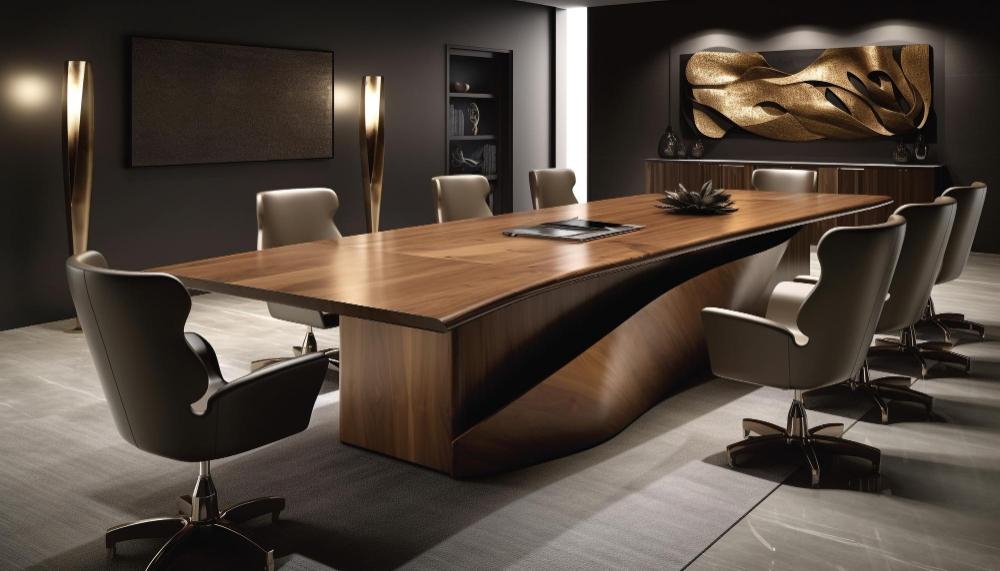
One aspect of custom office furniture that buyers sometimes underestimate is the installation process. A complex custom piece — particularly a large reception installation, a built-in executive wall unit, or a conference table with integrated technology — requires skilled installation that's as much a part of the final result as the fabrication.
Confirm before signing that the maker handles installation or coordinates it with qualified installers, and that the installation process accounts for the realities of your space — building access restrictions, elevator dimensions, working around existing infrastructure, timing relative to other construction or move-in activities.
Maintaining and Protecting Your Investment
Good custom office furniture, properly maintained, lasts a very long time. Most wood surfaces benefit from periodic conditioning and should be protected from prolonged direct sunlight, which causes fading and drying. Metal finishes may require occasional cleaning with appropriate products. Lacquered surfaces, while durable, can chip if struck sharply and may need touch-up work over time.
Ask your maker for specific care guidance for the materials in your pieces before installation. This information is easy to communicate at delivery and disproportionately valuable over the life of the furniture.
Build the Office Your Business Deserves
Custom office furniture isn't a luxury for businesses that have run out of things to spend money on. It's a strategic investment in the environment where your team does their best work, your clients form their most lasting impressions, and your brand communicates its values in three dimensions.
The businesses that get this right build spaces that serve them for decades — spaces their teams are proud to work in and their clients remember long after the meeting ends.
Start your custom furniture journey today. Talk to a maker who understands both design and your business goals — and build something that was made for exactly who you are.

 English
 Arabic
 French
 Spanish
 Portuguese
 Deutsch
 Turkish
 Dutch
Dutch
 Italiano
 Russian
 Romaian
 Portuguese (Brazil)