


Two Worlds Colliding in the Most Productive Way
Most conversations about AI in industrial automation stay firmly inside the factory gates. Better throughput. Lower defect rates. Smarter logistics. All legitimate, all valuable.
But there's a bigger story unfolding — one that connects the assembly lines of American industry to the command centers of US national defense. It's not a metaphor. It's supply chain reality, technology transfer, and strategic investment all converging at once.
Understanding this connection doesn't just make you a more informed reader. If you're in manufacturing, defense contracting, or industrial technology, it gives you a clearer picture of where the real investment is flowing and why.
The Supply Chain Behind Modern Defense Depends on Industrial AI
Let's start with the foundation. The US defense sector doesn't manufacture most of what it uses in-house. It depends on a vast network of industrial suppliers — metal fabricators, electronics manufacturers, composite material producers, precision machinists. These are American factories, and their ability to deliver at scale, on spec, and on schedule is a national security issue.
That's not hyperbole. During periods of high demand — think rapid procurement during geopolitical escalation — the limiting factor isn't often budget. It's manufacturing capacity and quality. A missile guidance component that fails quality inspection doesn't get shipped. A supply chain that can't scale under pressure becomes a vulnerability.
This is why the Department of Defense has quietly become one of the biggest advocates for modernizing American industrial manufacturing. When the DoD pushes suppliers to adopt AI in industrial automation, it's not being trendy. It's protecting its own supply chain resilience.
What Autonomous Drone Technology Is Teaching Industrial Engineers
Here's where the technology transfer story gets genuinely fascinating.
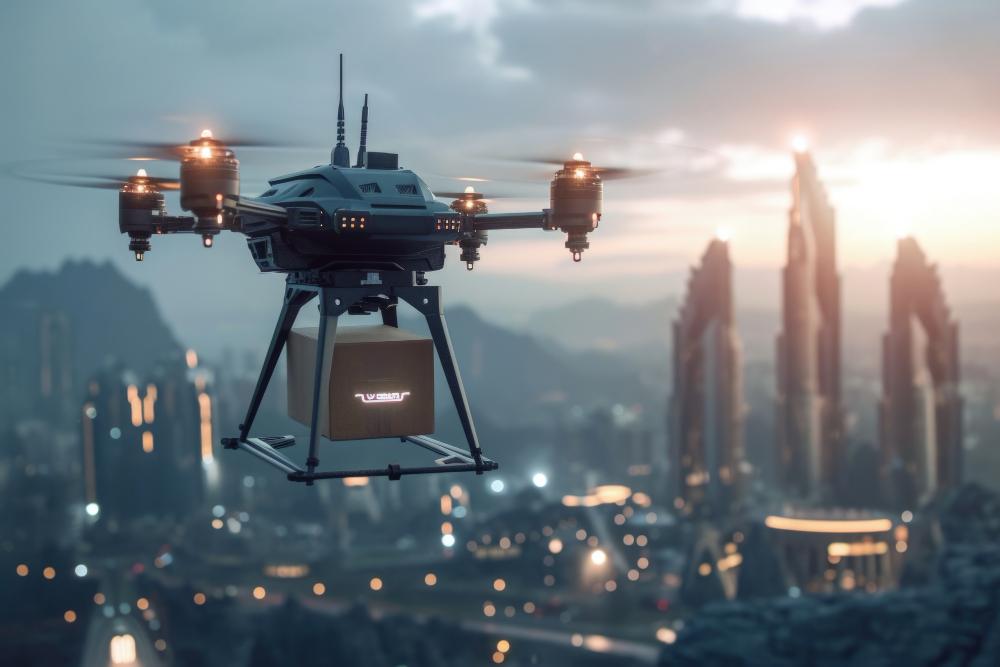
The development of autonomous drone systems — particularly systems designed to operate in coordinated groups — has become one of the most intense areas of AI research in the US. A military drone swarm isn't just a collection of individual drones flying in formation. It's a networked AI system where individual units share information, adapt to losses, reassign objectives, and make collective decisions without waiting for a human to issue each command.
Building that requires solving problems that are ferociously difficult. How do you manage real-time communication between dozens of autonomous agents? How do you handle partial failures without losing the whole mission? How do you build systems that adapt to environments they've never encountered?
The engineers working these problems are developing frameworks, algorithms, and hardware architectures that don't stay locked in classified programs forever. Over time, they migrate — through research publications, through workforce movement, through dual-use technology investment — into civilian industrial applications.
The result? Warehouse management systems that coordinate autonomous vehicles the same way drone swarms coordinate individual units. Factory floor sensor networks that share data and make distributed decisions. Logistics AI that re-routes and re-prioritizes dynamically when disruptions occur.
Defense innovation is seeding industrial AI capability in ways that don't make headlines but absolutely shape the technology landscape.
Counter-Drone Tech and What It Demands from AI
On the other side of the equation, drone swarm defense presents a completely different AI challenge — and an equally important one for industrial technology.
Defending against swarm attacks means building systems that can track multiple fast-moving targets simultaneously, distinguish threats from non-threats in real-time, and respond faster than any human operator could. The sensor fusion requirements alone are staggering. You're pulling data from radar, optical systems, acoustic sensors, and RF detectors and synthesizing it into actionable intelligence within milliseconds.
Now translate that to an industrial context. A smart manufacturing facility monitoring hundreds of machines, thousands of sensors, and dozens of concurrent processes is dealing with a similar data synthesis challenge — different stakes, same underlying computational problem. The AI architectures developed to handle drone defense scenarios inform how industrial AI systems handle high-dimensional, real-time monitoring at scale.
This is not a coincidence. It's why defense research budgets consistently produce civilian technology spillovers. The hardest problems in defense AI happen to be closely related to the hardest problems in industrial AI.
The Strategic Investment Picture for US Industrial Players
Government funding is tilting toward dual-use technology. Programs through DARPA, the DoD's Manufacturing Technology program, and various defense innovation offices increasingly focus on technologies that serve both military and commercial manufacturing purposes. If your company is in industrial AI, understanding these funding streams is worth your time.
The reshoring movement has a technology mandate. Bringing manufacturing back to American soil is a policy priority, but it only works economically if those domestic facilities are competitive. Productivity gains from AI in industrial automation are what make US manufacturing cost-competitive in categories where it previously couldn't be. Reshoring and industrial AI are strategically linked.
Workforce development is a shared challenge. Both the defense industrial base and commercial manufacturing face the same talent gap. Workers who understand AI systems, robotics, and automated process management are in short supply and high demand. Companies investing in training programs now are building moats against future hiring competition.
Practical Implications for Manufacturers in the US Defense Supply Chain
If you're a manufacturer supplying to defense primes or government contracts, the expectation around AI adoption is rising fast. Here's what that means practically:
Compliance and traceability requirements are increasing. AI-powered quality management systems that create complete, searchable records of every inspection decision are becoming standard expectations, not differentiators.
Cybersecurity standards for connected industrial systems are tightening. AI systems on factory floors are networked systems. Defense contractors face strict cybersecurity compliance requirements (CMMC, for instance), and AI implementations need to be built with those standards in mind from the start, not retrofitted later.
Responsiveness and scalability matter more than ever. A defense contract that needs surge capacity in 90 days requires a manufacturing partner whose AI systems can actually flex with demand. Static, scripted automation can't do that. Intelligent automation can.
The Bigger Picture Is Worth Holding
American manufacturing is entering a period where its technological capability and its national security relevance are more intertwined than they've been since World War II. The factories building components for autonomous systems, the AI researchers solving swarm coordination problems, the industrial engineers deploying predictive analytics on production lines — they're all part of the same strategic ecosystem.
AI in industrial automation sits at the center of that ecosystem. It's the capability layer that determines whether American industry can deliver at the quality, speed, and scale that both commercial competition and national security demands require.
That's a compelling reason to invest, a compelling reason to upskill, and a compelling reason to take the technology seriously rather than treating it as a future concern.
If you're a US manufacturer navigating AI adoption — whether you're defense-adjacent or purely commercial — now is the time to build your roadmap. Evaluate your current automation maturity, identify where AI can close your biggest performance gaps, and connect with industrial AI specialists who understand both the technology and the regulatory landscape. The opportunity window is open. Don't wait for it to narrow.

 English
 Arabic
 French
 Spanish
 Portuguese
 Deutsch
 Turkish
 Dutch
Dutch
 Italiano
 Russian
 Romaian
 Portuguese (Brazil)