


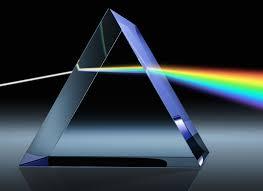
In the field of high-precision optics, the prism is a fundamental yet incredibly versatile component. While many people associate a prism with creating rainbows from sunlight, its role in the professional optoelectronics industry is much more complex. Prisms are essential for bending light, inverting images, and splitting wavelengths in everything from military-grade binoculars to the latest Augmented Reality (AR) headsets.
At ARVR Optical, we specialize in the design and manufacturing of high-performance optical prisms. Understanding the technical nuances of these components is vital for engineers and procurement professionals who require absolute precision in their optical paths.
What is an Optical Prism?
An optical prism is a transparent optical element with polished, flat surfaces that refract or reflect light. Unlike a mirror, which reflects light from a coated surface, a prism often utilizes Total Internal Reflection (TIR) to redirect light with significantly higher efficiency and less light loss.
Prisms are typically made from high-quality glass substrates like N-BK7 or Fused Silica, depending on the wavelength and thermal stability required by the application.
Common Types of Prisms and Their Functions
At ARVR Optical, we categorize prisms based on how they manipulate light. Here are the most widely used types in the industry today:
1. Right Angle Prisms
This is the most common type. It is used to deviate a light path by $90^\circ$ or $180^\circ$. By utilizing the hypotenuse face for reflection, it acts as a more durable alternative to a standard mirror.
-
Best For: Periscopes, boresights, and alignment systems.
2. Dove Prisms (Image Rotators)
A Dove prism is a truncated right-angle prism. When a Dove prism is rotated, the image passing through it rotates at twice the speed of the prism itself.
-
Best For: Interferometry, astronomy, and pattern recognition.
3. Roof Prisms (Amici Prisms)
These prisms are used to invert or revert an image while deviating the line of sight by $90^\circ$. They are crucial for maintaining a compact design in optical systems.
-
Best For: Binoculars and spotting scopes where upright images are required.
4. Beam Splitter Prisms
Constructed by joining two right-angle prisms at the hypotenuse with a specialized coating in between, these are used to divide a single beam of light into two separate paths.
-
Best For: Laser systems and AR/VR display engines.
Technical Specifications for Procurement
For an expert buyer, the value of a prism is determined by its manufacturing tolerances. At ARVR Optical, we maintain strict quality control over the following metrics:
-
Angle Tolerance: Measured in arcminutes or arcseconds. Even a tiny deviation in the angle can result in a significant "pointing error" in long-distance laser systems.
-
Surface Quality (Scratch-Dig): We offer surface qualities as high as 10-5, which is necessary for high-power laser applications to prevent surface damage.
-
Surface Flatness: Usually specified as $\lambda/10$ or better, ensuring that the wavefront of the light remains undistorted as it passes through the glass.
-
Material Homogeneity: Ensuring the glass substrate is consistent throughout to prevent internal refraction errors.
Comparison: Prism vs. Mirror
| Feature | Optical Prism (ARVR Optical) | Standard Optical Mirror |
| Durability | High (Internal surfaces protected) | Moderate (Coating exposed) |
| Efficiency | Very High (via TIR) | Moderate (Absorption losses) |
| Alignment | Permanent (Solid block) | Requires adjustment/mounts |
| Complexity | High (Requires precise angles) | Low |
Applications in AR/VR and Wearable Tech
One of the most exciting growth areas for ARVR Optical is the use of micro-prisms in wearable displays. In Augmented Reality, prisms are used to "fold" the optical path, allowing for slim, lightweight glasses that can still project a large, high-definition image into the user's eye.
By combining prisms with Waveguide technology, manufacturers can create "see-through" displays. The prism acts as the entry-point for the light from the micro-display (like a Micro OLED), directing it into the waveguide where it is expanded for the viewer.
Industrial and Medical Use Cases
Beyond consumer tech, prisms remain the backbone of several critical sectors:
-
Medical Endoscopy: Micro-prisms allow for high-resolution imaging inside the human body by bending light around tight corners in surgical tools.
-
Surveying & Metrology: Total stations and laser levels rely on high-precision corner cube retroreflectors (a type of prism) to measure distances with millimeter accuracy.
-
Aerospace & Defense: Prisms are used in pilot Head-Up Displays (HUDs) to overlay flight data onto the cockpit glass without obstructing the view.
Why ARVR Optical is the Industry Choice
Choosing a supplier for your prism needs requires a partner who understands the physics of light. At ARVR Optical, we provide:
-
Custom Coating Capabilities: From Anti-Reflective (AR) to Metallic or Dielectric coatings, we optimize the prism for your specific wavelength.
-
Advanced Substrates: We work with N-BK7, Fused Silica, Sapphire, and Infrared materials like Germanium.
-
B2B Support: We assist in the transition from prototype to mass production, ensuring consistency across thousands of units.
Conclusion
The prism is much more than a simple glass block; it is a precision-engineered tool that enables the most advanced technology of our time. Whether you are building a new medical device, a tactical sight, or the next breakthrough in AR/VR, the quality of your prism determines the quality of your vision.
By trusting ARVR Optical, you are choosing a partner dedicated to optical excellence. We combine decades of industry experience with cutting-edge manufacturing to deliver prisms that meet the most demanding specifications.
Visit arvroptical.com today to view our full catalog or to speak with a technical expert about your custom optical project.

 English
 Arabic
 French
 Spanish
 Portuguese
 Deutsch
 Turkish
 Dutch
Dutch
 Italiano
 Romaian
 Portuguese (Brazil)
 Tiếng Việt